Overview and Inspection Summary
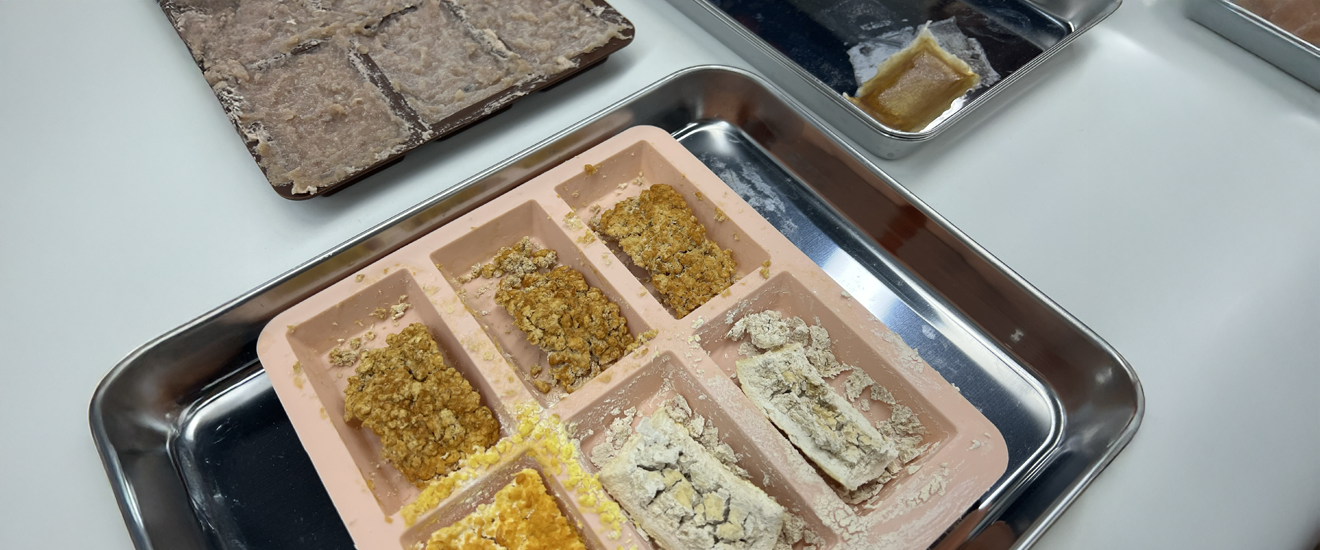
On September 27, 2026, samples from the second experimental series (Recipes 4–7), exploring mineral fillers CaCO3, Himalayan pink salt, activated charcoal) and cross-linked binders, were retrieved from the forced-air dehydrator after an initial 24-hour drying cycle for physical inspection. Following the initial casting and formulation trials documented on 21 September 2026, the specimens for Recipe Trials 4–7 underwent extended desiccation. This entry details the post-dehydration audit, structural analysis, and comparative insights.
Detailed Recipe Audit and Formulations (Recipe Trials 4–7)
-
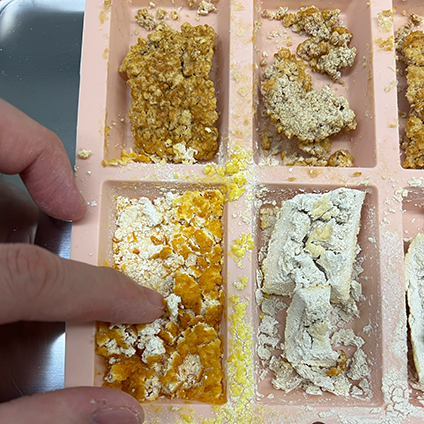
Recipe Trial 4 (CaCO3 Composite)
Dehydrator (24 hrs):
- Rice-crisp
- Fragile & Brittle -
Recipe Trial 5 (Modified CaCO3 Seaweed Composite)
Dehydrator (24 hrs):
- Dry Plaster
- Harder Chalky Finish
-
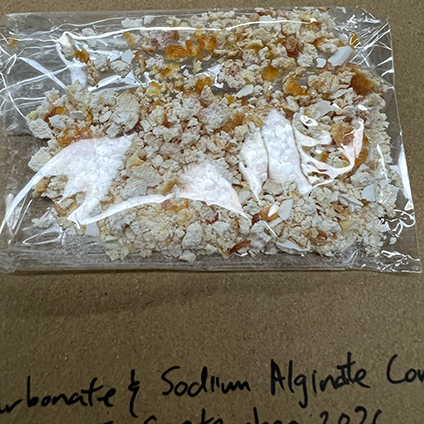
Recipe Trial 6 (Modified CaCO3 Sodium Alginate Composite)
Dehydrator (24 hrs):
- Solid Creme Brûlée
- Highest Strength -
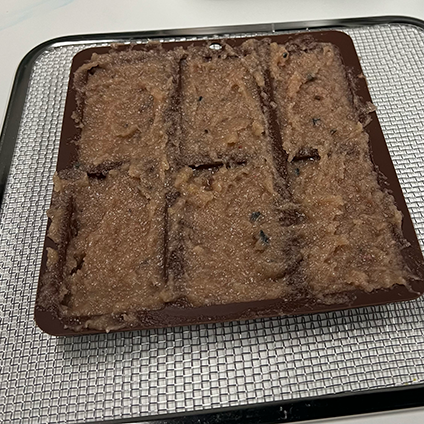
Recipe Trial 7 (Himalayan Pink Salt, Seaweed and
Charcoal Gelatin Composite)
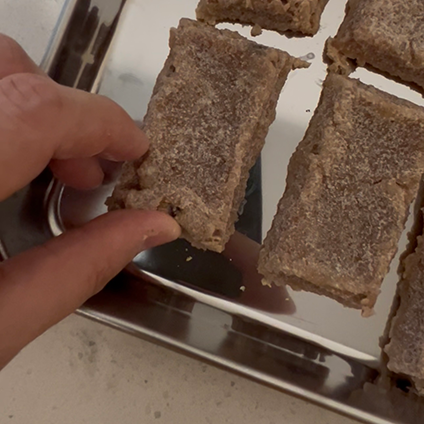
Dehydrator (24 hrs):
- Mushy Core
- Re-Dehydrate +24 hrs
Contextual Research and Material Precedents
To establish a theoretical foundation for mineral filler incorporation and ionic cross-linking kinetics, research was conducted into inorganic biocomposites and hydrocolloid drying mechanics:
- Inorganic Mineral Filler Mechanics (CaCO3 Particle Loading): Calcium carbonate (CaCO3) acts as an inorganic structural filler that increases density and opacity while reducing volumetric shrinkage. However, insufficient binder hydration (as observed in Trial 4) prevents complete polymer wetting around mineral particles, resulting in void entrapment, a fragile "rice-crisp" microstructure and poor compressive strength.
- Divalent Ionic Gelling (Sodium Alginate and CaCl2 Glazing): Sodium alginate cross-links in the presence of divalent calcium ions (Ca2+), forming an egg-box molecular structure. Combining CaCO3 paste with a surface glaze of CaCl2 solution (Trial 6) creates a hard, ceramic-like shell with superior structural integrity compared to pure polysaccharide matrices.
- Thermodynamics of Mold-Constrained Evaporation: Deep, non-porous silicone cavity molds create severe airflow bottlenecks along the bottom boundary layer. Because water vapor can only escape from the top exposed surface, steep internal moisture gradients develop, trapping residual liquid in the core and causing structural cracking upon forced-air dehydration.
Visual Moodboard and Design Intent
Alternative Craft and Traditional Material References
Critical Design Reflection
Reflecting on Week 7, evaluating the post-dehydration failure modes of Trials 4 through 7 marked an essential turning point in mastering binder-to-filler ratios and mold geometry. Moving from Trial 4's brittle, under-hydrated "rice-crisp" structure to Trial 6's dense, high-strength "crème brûlée" composite demonstrated that doubling hydration and using sodium alginate as a primary cross-linking binder drastically improves mechanical performance.
However, Trial 7's mushy core highlighted the severe limitations of high-load salt aggregates, where extreme hygroscopicity traps water within the crystalline matrix and overburdens forced-air drying. These insights clearly dictate our next strategic steps: we must abandon deep silicone cavity molds in favor of flat, ventilated metal trays, while isolating individual mineral additives, such as fine activated charcoal and inorganic salts, to evaluate their specific impacts on structural stability and moisture migration.
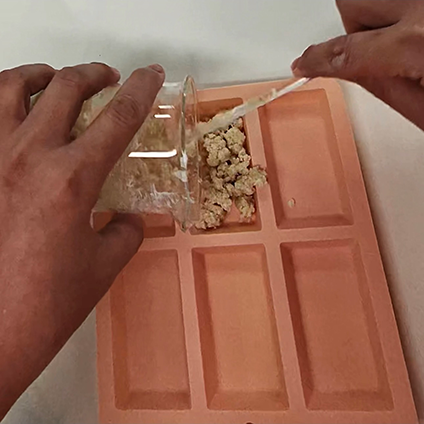
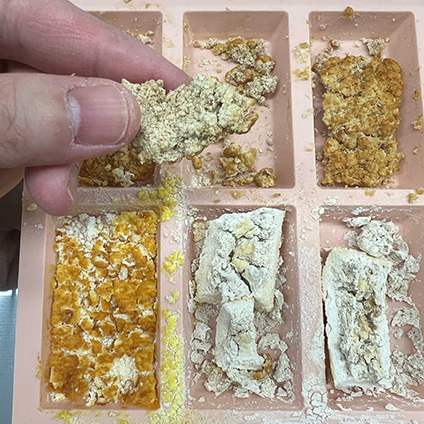
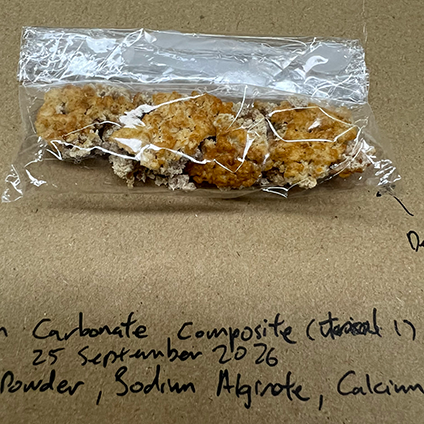
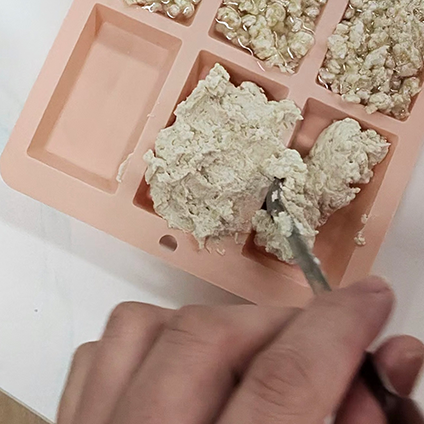
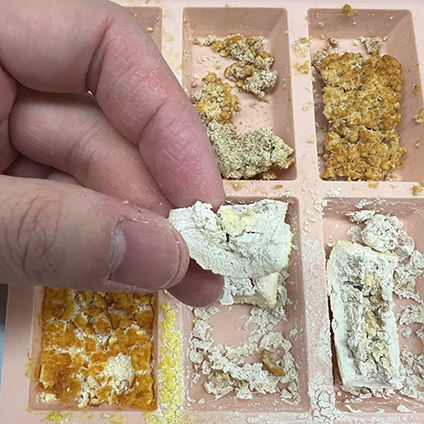
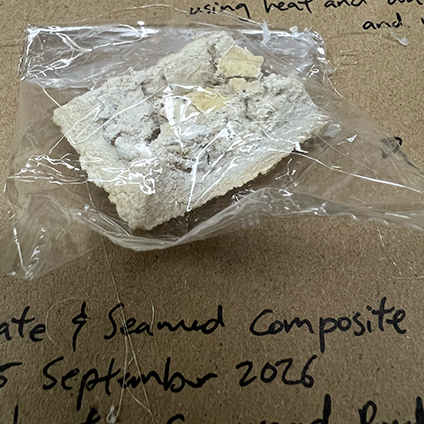
Recipe Trial 4: CaCO3 Ceramic Composite
Cast Date: 25 September, 2026 | Mould: Pink Silicone Rectangular Tray
[Dehydrator (24 hrs) → Popcorn texture → Rice-crisp → Fragile and Brittle]
- Formulation Parameters: Water (22 ml), CaCO3 Paste (20 g), Seaweed Powder (15 g), Sodium Alginate (5 g), CaCl2 Cross-Linking Solution.
- Process Observations: Mixing yielded a thick, sticky, lumpy mass resembling egg white folded into flour. The insufficient water volume prevented homogeneous binder dispersion, resulting in a popcorn-like, spongy pre-cure texture.
- Casting and Microstructure: Dehydration converted the popcorn-like texture into a fragile, rice-crisp-like structure. The cured sample crumbled easily under minimal tactile pressure and retained internal moisture, exhibiting severe structural weakness due to incomplete cross-linking and void entrapment.
Recipe Trial 5: Modified CaCO3 Seaweed Composite
Cast Date: 25 September, 2026 | Mould: Pink Silicone Rectangular Tray
[Dehydrator (24 hrs) → Putty slurry → Dry Plaster → Harder Chalky Finish]
- Formulation Parameters: Water (44 ml), Calcium Carbonate Paste (40 g), Seaweed Powder (25 g), Calcium Chloride Solution (reused balance for cross-linking glaze).
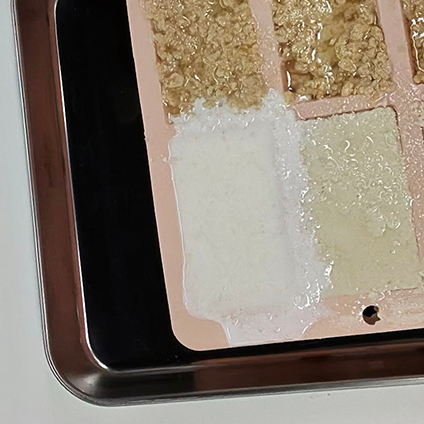
- Process Observations: Doubling hydration and removing sodium alginate formed a uniform, pale-yellow paint-like slurry. The material filled mold cavities smoothly and set into a tofu-like firm solid prior to drying.
- Casting and Microstructure: Fully desiccated into a hard, chalky matrix resembling dried plaster or limestone. While the surface crumbled under heavy localized pressure, it demonstrated significantly higher structural compression resistance than Recipe 4.
Recipe Trial 6: Modified CaCO3 Sodium Alginate Composite
Cast Date: 25 September, 2026 | Mould: Pink Silicone Rectangular Tray
[Dehydrator (24 hrs) → Plaster slurry → Solid Creme Brûlée → Highest Strength]
- Formulation Parameters: Water (44 ml), Calcium Carbonate Paste (40 g), Sodium Alginate (10 g), Calcium Chloride Solution (reused balance for cross-linking glaze).
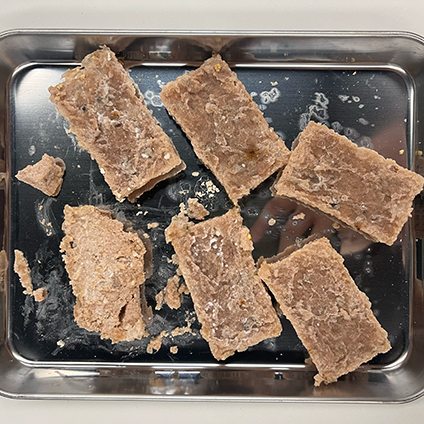
- Process Observations: Reverting to sodium alginate as the sole binder with double hydration yielded a smooth, white, Plaster-of-Paris-like slurry that filled mold cavities with high precision and zero air gaps.
- Casting and Microstructure: Achieved the highest structural integrity among all mineral composite trials, remaining almost fully intact post-drying. The top surface exhibited a browned "crème brûlée" visual finish (likely due to cross-tray vapor or residue transfer during drying), while the internal core retained a dense, chalky white structure with minor moisture traces in micro-crevices.
Recipe Trial 7: Himalayan Pink Salt, Seaweed and Charcoal Gelatin Hard-Cast Composite
Cast Date: 26 September, 2026 | Mould: Brown Silicone Rectangular Tray
[Dehydrator (24 hrs) → Salt-Charcoal → Mushy Core → Re-Dehydrate +24 hrs]
- Formulation Parameters: Water (250 ml), Seaweed Powder (15 g), Fine Grain Himalayan Pink Salt (150 g), Activated Charcoal Powder (15 g), Gelatin Powder 200 Bloom (20 g), Glycerol (5 ml), Beeswax (1 g).
- Process Observations: High salt concentration rapidly bound free water, converting the mixture into a stiff, wet-cement-like black aggregate. Cooking yielded a dense, uniform black paste that was manually packed into silicone molds.
- Casting and Microstructure: After 24 hours of forced-air dehydration, the sample remained soft and mushy beneath the surface. Tactile probing confirmed high internal moisture retention due to the hygroscopic nature of the salt filler, requiring an additional 24-hour dehydration cycle.
Summary Tables for Recipe Trials 4–7
-
Recipe Trial 4
(CaCO3 + Seaweed + Alginate)
Pre-Cure Consistency:
Lumpy / Popcorn slurry
Cured Visual Finish:
Fragile Rice Crisp
Desiccation State:
Incomplete
(Damp core)
Structural Integrity:
Lowest
(Crumbles easily) -
Recipe Trial 5
(CaCO3 + Seaweed)
Pre-Cure Consistency:
Smooth Putty / Paint
Cured Visual Finish:
Dry Limestone / Plaster
Desiccation State:
Complete
Structural Integrity:
Moderate
(Firm chalky) -
Recipe Trial 6
(CaCO3 + Alginate)
Pre-Cure Consistency:
Plaster of Paris Slurry
Cured Visual Finish:
Crème Brûlée / White Core
Desiccation State:
Near Complete
(Trace gaps)
Structural Integrity:
Highest
(Intact solid) -
Recipe Trial 7
(Salt + Charcoal + Gelatin)
Pre-Cure Consistency:
Stiff Wet Cement
Cured Visual Finish:
Pitch Black Aggregate
Desiccation State:
Incomplete
(Mushy core)
Structural Integrity:
Pending
(+24h Drying)
Key Takeaways and Learned Insights
- Cavity Mold Airflow Bottlenecks: Deep silicone molds restrict bottom surface ventilation, trapping moisture against mold walls and leading to non-uniform drying, surface cracking and structural crumbling upon desiccation.
- Hygroscopic Moisture Retention: High-load mineral aggregate formulations (such as fine pink salt) bind water tightly within their crystal lattice, requiring extended forced-air dehydration (40+ hours) to achieve full core desiccation.
- Cross-Linking Surface Integrity: Sodium Alginate paired with CaCO3 and external CaCl2 cross-linking glaze forms the most structurally intact, plaster-like mineral core among all tested composite formulations.
Strategic Action Plan
- Isolate Fillers (Salt vs. Charcoal): Cast standalone baseline trials for Fine Pink Salt and Activated Charcoal to isolate their individual impacts on structural rigidity, bacterial suppression and moisture absorption.
- Rice Flour Starch Matrix Trial: Introduce Rice Flour (25 g) as an organic starch filler to test amylose / amylopectin gelatinization for smooth, opaque sheet formulations.
- Aesthetic Marbling and Natural Dyes: Experiment with dual-pour swirl techniques using food-safe natural pigments to create marbled surface finishes.
- Dual-Texture Mold Experiments: Combine smooth silicone casting with raw or textured contact plates to produce bioplastic sheets with dual rough / smooth surface finishes.