Comparative Curing Audit (Air-Dried vs Forced-Air Dehydration)
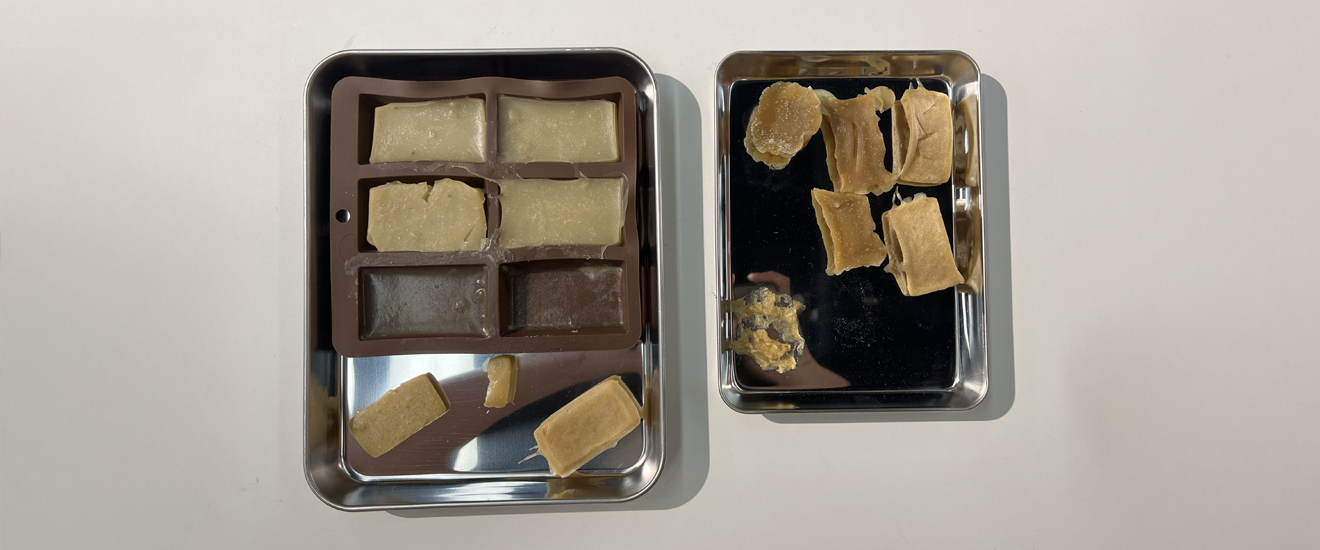
Inspection of samples from Recipes 1, 2 and 3 was conducted on September 21, comparing 48-hour ambient air-dried specimens against 24-hour machine-dehydrated specimens.
-
Recipe Trial 1
(Pure Seaweed + CaCl2)
Air-Dried (48 hrs):
- Elastic and bouncy
- Surface cracks
- Bonding tears -
Recipe Trial 2
(Seaweed + Agar)
Air-Dried (48 hrs):
- Firm, bouncy, solid
- NO surface cracks -
Recipe Trial 3
(Seaweed + Gelatin)
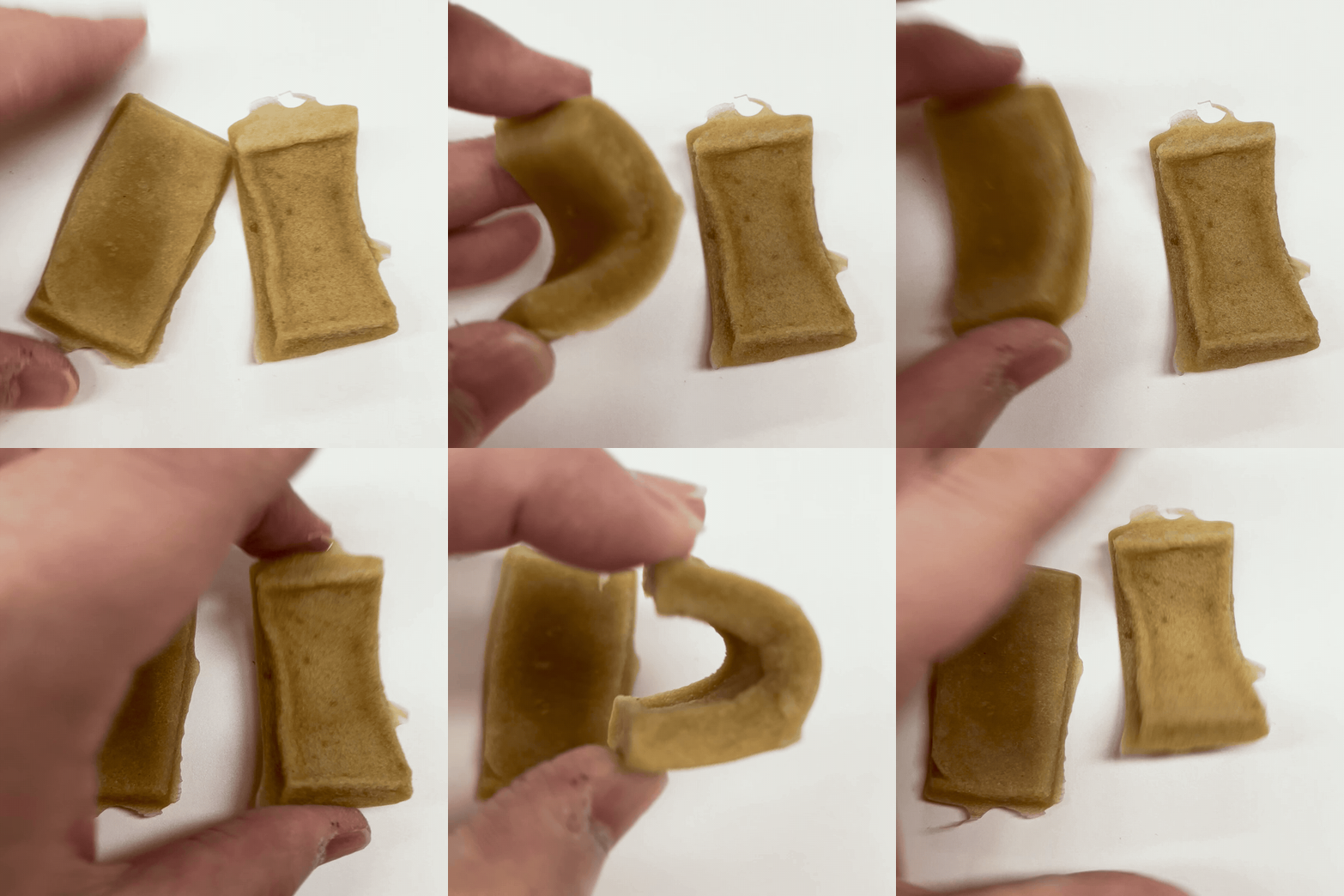
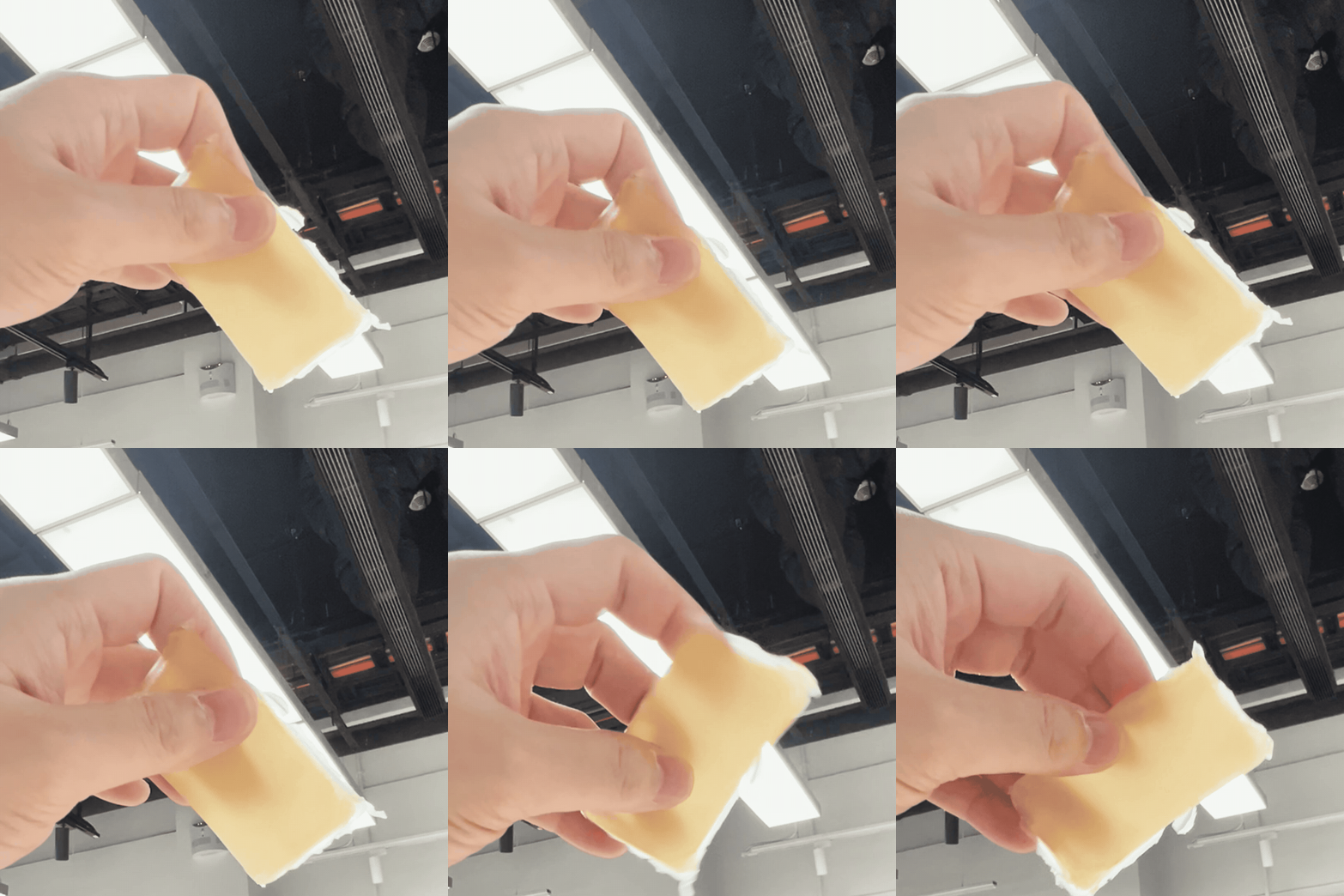
Air-Dried (48 hrs):
- Ultra-flexible (eraser-like)
- Bends and twists
-
Recipe Trial 1
(Pure Seaweed + CaCl2)
Dehydrated (24 hrs):
- Shriveled, hard, rubbery
- Snaps easily under force -
Recipe Trial 2
(Seaweed + Agar)
Dehydrated (24 hrs):
- Shriveled, hard, rubbery
- High tensile resistance -
Recipe Trial 3
(Seaweed + Gelatin)
Dehydrated (24 hrs):
- Shriveled, rubbery; minor
- Surface desiccation cracks
Recipe Trial 1 (Pure Seaweed + CaCl2)
Air-dried samples retained elasticity but exhibited surface cracks and tearing, indicating weak bonding. Dehydrated samples shriveled into a hard, rubbery mass that tears under minimal force, making it the structurally weakest formulation.
Recipe Trial 2 (Seaweed + Agar)
Air-dried samples produced a firm, solid, bouncy material reminiscent of a high-durometer rubber ball, with no surface cracking. Dehydrated samples hardened and shriveled without remaining bouncy, providing the highest structural firmness and tensile resistance across all three formulations.
Recipe Trial 3 (Seaweed + Gelatin)
Air-dried samples yielded the highest flexibility, able to bend and twist like an eraser. Dehydrated samples shriveled into a rubbery solid; while rapid moisture loss caused surface micro-cracking, it remained the most flexible of all machine-dried samples.

Material Circularity Experiment
To evaluate whether the material can break down safely into a non-toxic liquid and be recycled, an air-dried sample block of Recipe Trial 3 (Seaweed and Gelatin) was heated in a pot with 200 ml of added water.
- Thermal Breakdown: The material fully dissolved into a clear, high-viscosity solution without residual solids or green film, resembling molten resin or diluted glue.
- Secondary Curing and Properties: Cooling evaporated the liquid into a glossy film. Agitation yielded a glue-like rubbings mass, which was successfully re-heated, poured into a silicone mold and air-dried for 24 hours.
- Recast Outcome: The secondary sample formed an opaque, translucent, jelly-like rubber. Due to higher residual water content, it exhibited lower tensile strength and tore easily. This sample has been placed in the dehydrator to benchmark its secondary mechanical properties during the September 28 consultation.
Contextual Research and Material Precedents
To ground our initial hydrocolloid durometer comparisons and material circularity tests within biopolymer engineering and industrial material science:
- Hydrocolloid Durometer Synergies (Agar vs. Gelatin vs. Carrageenan): Blending carrageenan with secondary hydrocolloid networks alters polymer chain mobility and mechanical durometer in distinct ways. Agar-agar forms rigid, hydrogen-bonded double helices that maximize tensile resistance and structural bounciness (Trial 2), whereas gelatin's flexible triple-helix polypeptide chains provide high elastomeric compliance and eraser-like flexural recovery (Trial 3).
- Thermo-Reversible Polymer Circularity and Scrap Re-Pulping: Gelatin-seaweed hydrogels exhibit physical thermo-reversibility, where non-covalent cross-links break down upon thermal activation in water (>65°C) without chemical degradation. This re-melting capability mirrors closed-loop industrial scrap re-pulping, allowing off-cuts and defective specimens to be re-dissolved, re-cast and re-cured into functional bio-composite sheets.
- Rheology of Solid Mineral Suspensions (CaCO3 Hydration Limits): Incorporating high solid loads of insoluble inorganic fillers (such as calcium carbonate paste) requires precise liquid-to-solid stoichiometry. Insufficient water carrier volume causes rapid particle agglomeration and "popcorn-like" shear thickening (Trial 4), whereas doubling the aqueous phase (Trials 5 and 6) enables complete binder wetting, smooth slurry flowability and high-fidelity mold reproduction.
Visual Moodboard and Design Intent
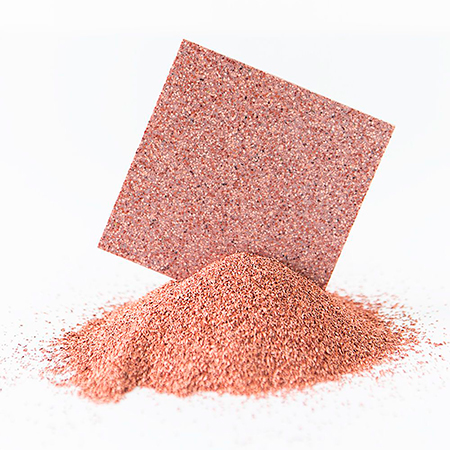
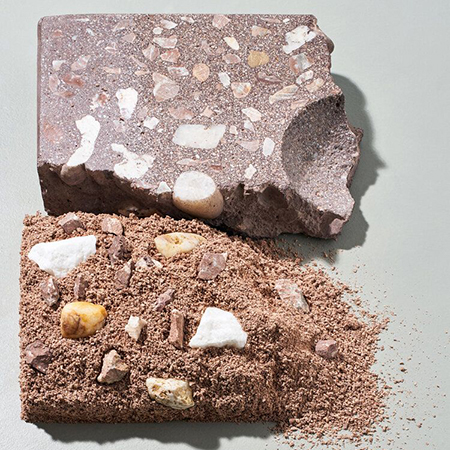
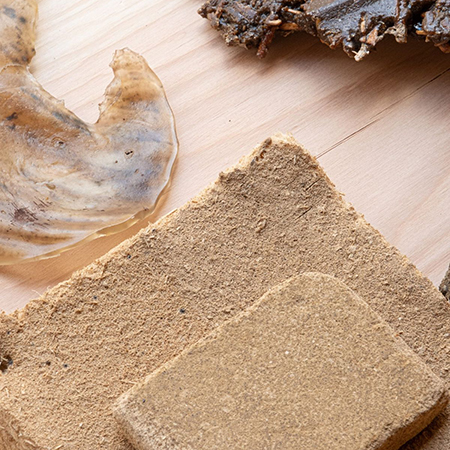
Alternative Craft and Traditional Material References
Critical Design Reflection
Reflecting on Week 6, comparing ambient air drying against forced-air machine dehydration across Trials 1 through 3 revealed crucial insights regarding drying kinetics and material durometer. While forced-air drying accelerates moisture removal, it causes severe volumetric shrinkage and embrittlement in pure carrageenan, CaCl₂ networks. However, secondary binders effectively counter this: agar-agar imparts structural firmness, while gelatin delivers high elastomeric flexibility.
Furthermore, our material circularity test on Trial 3 successfully demonstrated 100% thermo-reversible recyclability, confirming that cured hydrocolloid scraps can be completely re-dissolved in hot water and re-cast into new sheets. Pivoting into mineral composites in Trials 4 through 7 established that maintaining sufficient hydration (44 ml water vs. 22 ml) is critical to preventing lumpy slurry aggregation. These foundational findings dictate our next strategic phase: we must transition from deep silicone cavity molds toward flat, ventilated metal trays to eliminate drying bottlenecks and establish uniform planar stability across all upcoming composite swatches.
New Composite Formulations (Recipe Trials 4–7)
Moving beyond pure hydrocolloid sheets, experiments conducted from September 25 to 26 explored high-density mineral composites using Calcium Carbonate (CaCO3), Sodium Alginate, Fine Himalayan Pink Salt and Activated Charcoal.
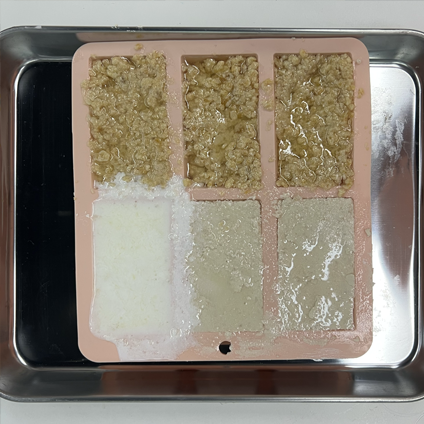
[Recipe Trial 4 (Lumpy Slurry) → Recipe Trial 5 (2x H2O + Seaweed) → Recipe Trial 6 (2x H2O + Alginate) → Plaster-like Slurry]
Recipe Trial 4: CaCO3 Ceramic Composite
Cast Date: 25 September, 2026 | Mould: Pink Silicone Rectangular Tray
- Formulation Parameters: Water (22 ml), CaCO3 Paste (20 g), Seaweed Powder (15 g), Sodium Alginate (5 g), CaCl2 Cross-Linking Solution.
- Process Observations: Inadequate hydration caused rapid, uneven gelling upon mixing, resulting in a thick, sticky, lumpy mass that resembled flour mixed with egg whites. The material became progressively lumpier during stirring and resisted heating in a pot without liquefying or softening.
- Casting and Microstructure: Molded samples exhibited a popcorn-like, spongy texture with significant trapped air gaps between cavities. External CaCl2 solution was poured over the filled mold to bridge voids and chemically lock the outer surface prior to machine dehydration.

Recipe Trial 5: Modified CaCO3 Seaweed Composite
Cast Date: 25 September, 2026 | Mould: Pink Silicone Rectangular Tray
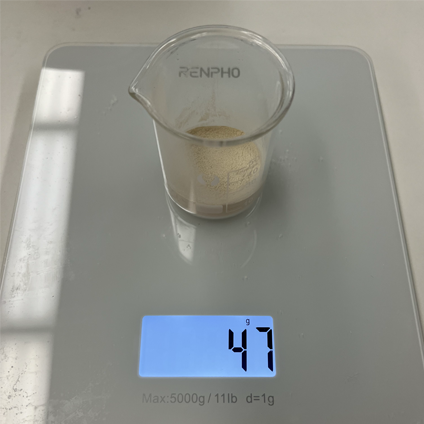
- Formulation Parameters: Water (44 ml), Calcium Carbonate Paste (40 g), Seaweed Powder (25 g), Calcium Chloride Solution (reused balance for cross-linking glaze).
- Process Observations: Doubling hydration and removing sodium alginate significantly improved homogeneity. The mixture formed a pale-yellow, paint-like slurry resembling ceiling patching putty.
- Casting and Microstructure: Poured smoothly into silicone cavities with minimal air entrapment, setting into a uniform, tofu-like firm solid prior to receiving a CaCl2 surface glaze.

Recipe Trial 6: Modified CaCO3 Sodium Alginate Composite
Cast Date: 25 September, 2026 | Mould: Pink Silicone Rectangular Tray
- Formulation Parameters: Water (44 ml), Calcium Carbonate Paste (40 g), Sodium Alginate (10 g), Calcium Chloride Solution (reused balance for cross-linking glaze).
- Process Observations: Reverting to sodium alginate as the sole binder at double hydration yielded a smooth, bright white slurry resembling Plaster of Paris with excellent flowability.
- Casting and Microstructure: Exhibited the highest casting precision among all composite trials, filling mold cavities completely with zero corner air gaps before being sealed with CaCl2 solution.
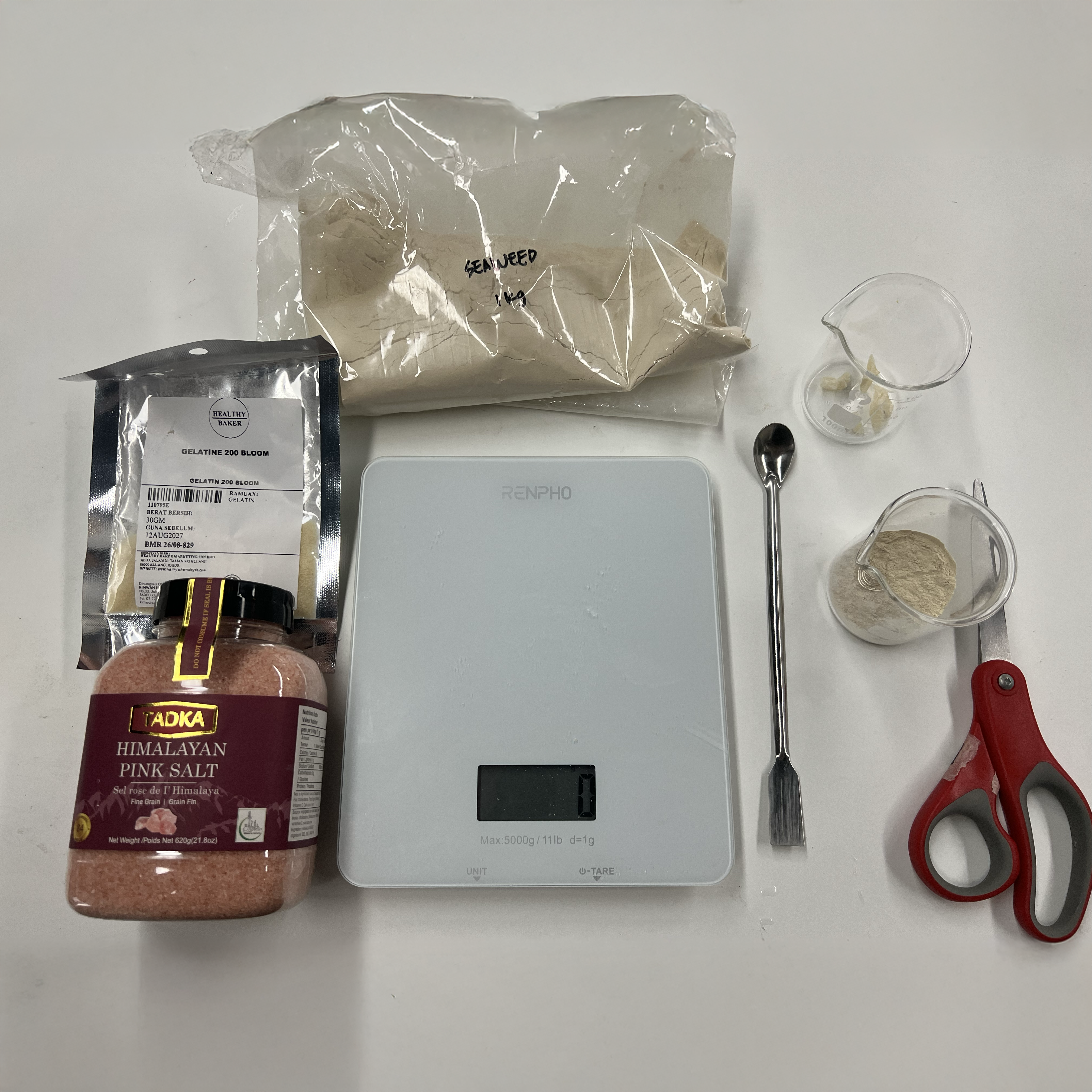


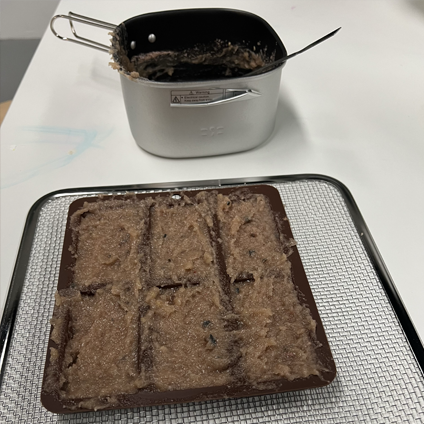
Recipe Trial 7: Himalayan Pink Salt, Seaweed and Charcoal Gelatin Hard-Cast Composite
Cast Date: 26 September, 2026 | Mould: Brown Silicone Rectangular Tray
- Formulation Parameters: Water (250 ml), Seaweed Powder (15 g), Fine Grain Himalayan Pink Salt (150 g), Activated Charcoal Powder (15 g), Gelatin Powder 200 Bloom (20 g), Glycerol (5 ml), Beeswax (1 g).
- Process Observations: Hydrating the salt aggregate caused rapid water absorption, converting the liquid matrix into a stiff, pinkish-black slurry with a wet-cement texture. Cooking thickened the slurry into a dense, pitch-black paste that exerted high mechanical resistance during stirring.
- Casting and Microstructure: While manual packing was messy due to high viscosity, the dense aggregate filled silicone cavities completely, forming a solid, opaque black composite sheet.
Summary Tables for Recipes 4–7
-
Recipe Trial 4
Binder Network:
Sodium Alginate + Seaweed
Filler / Additive:
CaCO3 Paste (20 g)
Liquid-to-Solid Ratio:
22 ml / 40 g
Processability and Flowability:
Poor; sticky, lumpy,
popcorn-like texture -
Recipe Trial 5
Binder Network:
Seaweed Powder (25 g)
Filler / Additive:
CaCO3 Paste (40 g)
Liquid-to-Solid Ratio:
44 ml / 65 g
Processability and Flowability:
Good; smooth putty/paint
consistency, tofu-like set
-
Recipe Trial 6
Binder Network:
Sodium Alginate (10 g)
Filler / Additive:
CaCO3 Paste (40 g)
Liquid-to-Solid Ratio:
44 ml / 50 g
Processability and Flowability:
Excellent; white, plaster-like slurry
with perfect mold reproduction -
Recipe Trial 7
Binder Network:
Gelatin (20 g) + Seaweed (15 g)
Filler / Additive:
Pink Salt (150 g) + Charcoal (15 g)
Liquid-to-Solid Ratio:
250 ml / 200 g
Processability and Flowability:
Thick, stiff cement slurry;
highly dense, pitch-black cast
Key Takeaways and Learned Insights
- Synergistic Hydrocolloid Durometers: Combining seaweed with secondary binders alters mechanical performance predictably: Agar-Agar maximizes structural firmness and dimensional stability, while Gelatin yields high elastomeric flexibility and bounciness.
- Thermoplastic Re-Melting Capability: Gelatin-seaweed biopolymers possess true thermo-reversible characteristics, dissolving completely in hot water to reform a clear resinous solution that can be recast and cured.
- Stoichiometric Hydration Thresholds: Mineral composite slurries containing Sodium Alginate and CaCO3 require higher liquid ratios (44 ml vs. 22 ml) to prevent premature gelling and lumpy "popcorn" aggregation during initial mixing.
Strategic Action Plan
- Review Dehydrated Composite Casts: Inspect machine-dried samples from Recipe Trials 4, 5, 6 and 7 on September 28 to evaluate structural density, shrinkage and surface hardness during project consultation session.
- Isolate Fillers (Salt vs. Charcoal): Cast standalone baseline trials for Fine Pink Salt and Activated Charcoal to isolate their individual impacts on structural rigidity, bacterial suppression and moisture absorption.
- Rice Flour Starch Matrix Trial: Introduce Rice Flour (25 g) as an organic starch filler to test amylose / amylopectin gelatinization for smooth, opaque sheet formulations.
- Aesthetic Marbling and Natural Dyes: Experiment with dual-pour swirl techniques using food-safe natural pigments to create marbled surface finishes.
- Dual-Texture Mold Experiments: Combine smooth silicone casting with raw or textured contact plates to produce bioplastic sheets with dual rough / smooth surface finishes.